
3D printers · Success stories
Success Story: 3D Printing in the Educational Environment

"Iași printed in miniature" - The story of the Faculty of Geography in Iași
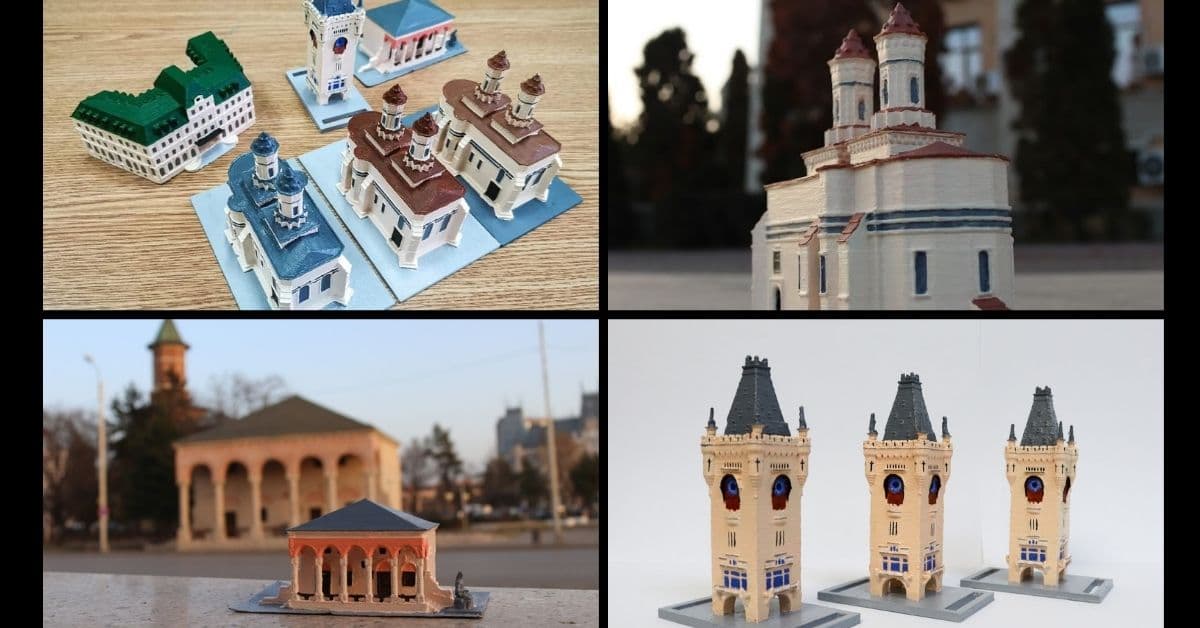
Today we are in the Digital Technologies Laboratory of the Faculty of Geography and Geology Iași, where Mr. assistant professor Dr. Lucian Roșu, together with his students, use 3D printing technology from IRIS Robotics to create a "spectacular model" of the city of Iași.Through this project, which did not escape the attention of either the newspapers or news channels, the students want to promote the city of Iasi at tourism fairs, with the help of realistic miniature 3D models that highlight important historical buildings, such as the Palace of Culture, Dosoftei House or the University "Alexandru Ioan Cuza".
Education, whether private or public, is one of the most exciting fields when it comes to adopting new technologies, largely due to the experimental and creative environment often oriented towards solving real problems encountered in society.
That's why we thought to find out, directly from Mr. assistant professor Dr. Lucian Roșu, who is in charge of the development and promotion of the laboratory, how you can use new technologies in an educational context to improve the experience of pupils and students, and remain relevant in an increasingly technological society.
Below is the full interview with Mr. Dr. Lucian Roșu, whom we thank for his answers, and we wish him success for future projects.IRIS Robotics: What do you think is the role of technology in education in general?
"With the incorporation of technology into the education process, the main goal is to change the way teachers and students collect, access, analyze, present and transmit information. This can democratize information in classrooms, as well as help personalize instruction according to the qualities of each student."IRIS Robotics: In an ideal world, how would you use technology in the educational process? And what would you most like to achieve with it?
"The risk of technological progress is to make us useless, to teach a computer/robot to do things better than humans and we become useless. For this very reason, I want technology to be a field of creation and innovation and not just a space for use. From the perspective of education in schools and universities, technology should be a technical support to understand and analyze phenomena more easily, regardless of the discipline studied. Just as in agriculture, we must also do in education the transition from weeding with a hoe to modern mechanized means."IRIS Robotics: What do you think are the main obstacles that have prevented you over time from achieving this ideal?
"The development of a mentality that works towards the objective of "learn throughout life" will lead to the acceptance of technologies as an integral part of our lives, of our education. For this reason, the training of us educators must have the component of accepting novelties in the educational process, so that they are also taken up in the speech to pupils/students. The biggest challenge is the fear of new technologies, and sometimes, also by the lack of support for the acquisition of these technologies."IRIS Robotics: What was the impact of these new technologies? And how did the students react?
"In recent years, I have gotten closer to technologies, precisely in order not to be a misfit in a technological society. I started using drones to analyze the geographic space, 3d printers to understand the planning of the geographic space, but also machine learning and artificial intelligence tools, until recently a sacred domain of data science specialists. I discovered these tools together with the students, through a few exercises and testing the technologies in various situations. These situations became undergraduate, dissertation or doctoral theses for the students I worked with – taking the knowledge of these technologies to another level.”IRIS Robotics: Did you have experience with this type of equipment before you purchased it? How difficult do you think it would be for someone who doesn't already have direct experience to learn to use this equipment well enough for educational purposes?
"Embracing new technologies met with some resistance on my part. I forced myself to understand the principles, the mechanisms, I analyzed youtube tutorials, read forums and when I did not understand, I confidently turned to the support teams of IRIS Robotics to understand a number of subtleties that come with the passage of time and experience. A manual of best practices that is available to educators would make understanding 3d printing much easier, first at the conceptual level and then at the application level. Also, a caravan of multimedia technologies would open new horizons for educators who are willing to adopt new technologies."IRIS Robotics: What are your plans for the future of the 3D printing laboratory in the Faculty of Geography and Geology?
"The role of an educator is that of an opener of horizons, as a result I also want to gather as many students as possible to understand and use 3d printing technology. I propose to give them the minimum knowledge and then, each of them to use the knowledge of these technologies in their own experiments, which can be launched as professional start-ups. Among the uses we see now are the creation of personalized souvenir products, scientific dioramas, digital 3d models of the land or even proposals for (re)organization of the inhabited and lived space."In conclusion
Adopting new technologies is undoubtedly a challenge, regardless of the type of organization.And overcoming these challenges largely depends on those involved, and on their willingness to overcome the obstacles presented to them, whether it is finding financial resources or time, or overcoming "fear of new technologies".
IRIS Robotics applauds and encourages leaders who support and fight for the technology and innovation of their organizations, and provides all the necessary support to facilitate the adoption of new technologies regardless of the field of application.

