

Autonomous nebulization disinfection robot
Reeman's autonomous misting robot disinfects quickly and effectively (according to the manufacturer, 1,000 m² in about 15 minutes) and sprays agents…
Price
Request a quote
Robots that disinfect wards, classrooms and offices while the rooms are empty. We help you choose the model, deliver it in Romania and train your team.
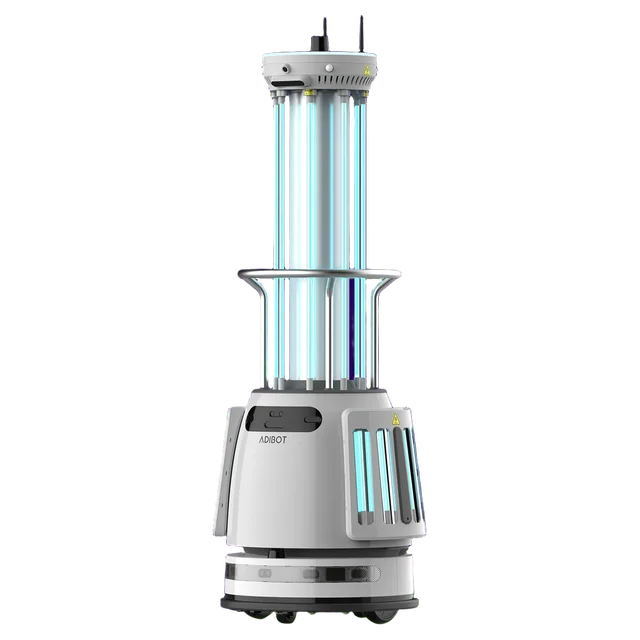
Both methods work with nobody in the room. They differ in what they use and where they reach.
| Criterion | UV-C light | Misting |
|---|---|---|
| How it disinfects | UV-C light breaks down the DNA and RNA of microorganisms, so they can no longer multiply | The robot sprays a disinfectant in 2-5 μm particles |
| What it uses | Light only, with no chemicals and no residue | Hypochlorous acid, chlorine dioxide, hydrogen peroxide or peracetic acid, as you choose |
| People in the room | No. UV-C light harms skin and eyes | No. You go back in after the time given for the disinfectant |
| Where it acts | On surfaces and in air reached directly by the light. Shadowed areas need another robot position | In the air and on surfaces in the zones chosen on the map |
| Speed, per the manufacturer | Adibot-A: 40 m² in 10 minutes | Reeman: about 1,000 m² in 15 minutes |
| Suited to | Wards, treatment rooms, classrooms and offices | Large spaces, clinics, schools and public transport |
| Models in our catalog | Adibot-A, Adibot-S, Reeman UV-C and the UVC robot we configure in Romania | The Reeman misting robot |
Figures and specifications come from the manufacturers' data sheets, on the product pages.
All models are supplied to order. Ask for a quote on the product page or write to us below.
Reeman's autonomous misting robot disinfects quickly and effectively (according to the manufacturer, 1,000 m² in about 15 minutes) and sprays agents…

Autonomous UV-C disinfection robot, set up and integrated by IRIS, with app control and reports. For areas over 1,000 m². Ask for a quote.

UBTECH ADIBOT-S Robot is a mobile UV-C disinfection robot that can be easily carried and controlled by remote smart app as well as remote control. It…

Autonomous UV-C disinfection robot Adibot-A can navigate autonomously and be controlled remotely. ADIBOT-A uses UV-C rays to disinfect air and…

Intelligent Autonomous Navigation, Automatic UV-C Disinfection Robot Reeman 180W autonomous UV-C disinfection robot has the characteristics of: fast…
UV-C light at 254 nm harms skin and eyes on direct exposure. That is why the robot follows a few simple rules, which we go through with your team at installation.
A cycle starts only when there are no people, animals or plants in the room. You put the warning sign on the door.
Models with presence sensors switch the lamps off when someone enters the work area. Each model's data sheet lists its sensors.
The cycle is watched from outside the room. Models with a camera or an app show the progress and alert you at the end.
UV-C light does not remove dirt. You do the usual cleaning first, then start the robot.
The light acts only in a direct line. Surfaces hidden behind furniture need a second robot position.
Standard 254 nm lamps are designed not to produce significant ozone. In small, closed rooms, air the room for a few minutes after the cycle.
Wherever surfaces are touched often and rooms stand empty for a while.
Wards, treatment rooms, operating theatres and consulting rooms, disinfected at night or between shifts.
Classrooms, labs, libraries and halls of residence, with the cycle run after classes.
Meeting rooms, common areas and shared desks, at the end of the working day.
Hotel rooms, dining rooms, checkouts and fitting rooms, between guests or after closing.
Airports, stations, waiting rooms and public transport, especially at night.
Large production and storage spaces, where the robot's battery life matters.
The floor area, the type of rooms and how many cycles you need per day or per week.
We choose the method, the model and the number of robots, so you do not pay for functions you do not need.
When a robot is available, we run a demonstration at your site or send you a video.
We map the space, train the people who will use the robot and propose a maintenance plan.
We also work with public institutions: our products are available through SEAP/SICAP, and we offer free consulting for EU-funded projects.
Cannot find the answer? Write to us or call us.
No. UV-C light at 254 nm harms skin and eyes, so the cycle runs only in empty rooms. You put the warning sign on the door and watch the cycle remotely.
A UV-C robot disinfects with light and no chemicals, but only the surfaces the light reaches directly. A misting robot sprays a disinfectant in fine particles and covers large spaces quickly.
It depends on the model. According to the manufacturers' data sheets, Adibot-A disinfects 40 m² in 10 minutes, and the Reeman misting robot covers about 1,000 m² in 15 minutes.
The manufacturers' data sheets state 99.9% for Adibot-A and Adibot-S and 99.9999% for viruses for the Reeman UV-C robot. The figures apply to surfaces reached directly by the light, under the conditions in each manufacturer's data sheet.
The lamps are replaced after the number of hours in the manufacturer's data sheet, between 8,000 and 12,000 hours for the models in our catalog. We sell replacement lamps and batteries and help you fit them.
We list the conformity documents for the chosen model in the quote, before you order, so you know exactly what you receive.
Yes, when a robot is available. The demonstration takes place at your site or through a video showing the robot at work.
Disinfection robots are supplied to order, and we confirm the lead time in the quote. For the UVC robot we configure, the software is installed and tested in Romania before delivery.
Yes. Our products are available through SEAP/SICAP, and we offer free consulting for EU-funded projects.
Answer four questions about the space and the schedule. See which technology is worth discussing and what to check before use.
UV-C or misting
The space allows both technologies. The choice depends on the schedule, the surfaces and the consumables.
The result is not a germicidal dose validation and does not calculate efficacy. It is not a medical diagnosis. Sizing follows the manufacturer's documentation, together with the person responsible for the space.
Tell us which spaces you want to disinfect and how often. We come back with the right model and a quote.
Which robot suits hospitals, schools, offices, hotels, shops and transport, a comparison of the solutions and how to choose the configuration, in 17 pages. We email you the PDF. The guide is in Romanian.
UV-C disinfection robots
PDF, 17 pages